Research Group Mobility Justice
Head: Dr.-Ing. David Duran-Rodas
Goal

The research group aims to create awareness, assess and addresses mobility injustices. The main methodology focuses on mixed methods approaches combining spatial analysis and machine learning with qualitative techniques.
To make our mobility just and including different needs and abilities, we propose as a first step that you feel what others feel. In other words, create awareness and empathy. The next step is to assess fairness, that is, who is privileged in terms of mobility opportunities and who is not. Finally, when you are aware and know the real situation, it is time to address it.
Projects
MGeM
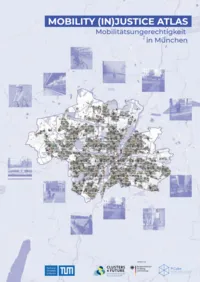
The project "Mobilitätsgerechtigkeit in Metropolregionen" (MGeM) explores socially disadvantaged groups and neighborhoods with sustainable mobility innovations including barriers and needs
The first deliverable is the creation of a mobility (in)justice atlas to show where social disadvantaged groups live in mobility disadvantaged areas in Munich's urban areas. You can find now the publication about the Mobility (In)Justice Atlas here: German and English.
SmartHubs
The SmartHubs project examines mobility hubs, dedicated on-street locations where citizens can choose from different shared and sustainable mobility options.
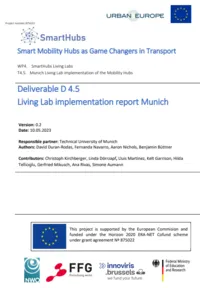
Mobility hub Living Lab Implementation Report Munich: Would you like to know more about how the Living Lab was planned, how it was evaluated, and which results were found? Then take a look at the current report from the SmartHubs team in Munich. You can find the report here: English.
Publications
2024
Mohamed Abouelela, David Durán-Rodas, Constantinos Antoniou (2024). Do we all need shared E-scooters? An accessibility-centered spatial equity evaluation approach.
https://www.sciencedirect.com/science/article/pii/S0965856424000338
María Teresa Baquero Larriva, Benjamin Büttner, David Durán-Rodas (2024). Active and healthy ageing: Factors associated with bicycle use and frequency among older adults- A case study in Munich.
https://www.sciencedirect.com/science/article/pii/S2214140524000185
2023
Geurs, A., Grigolon, A., Müzel, K., Gkiotsalitis, K., Duran-Rodas, D., Büttner, B., Pappers, J., Martines L., Graf, A., Hansel, J., Gkrava, R., Klenmentschitz, R. (2023). The SmartHubs integration ladder: a conceptual model for the categoristaiton of shared mobility hubs. SmartHubs.
D Arias-Molinares, Y Xu, B Büttner, D Duran-Rodas (2023). Exploring key spatial determinants for mobility hub placement based on micromobility ridership. Journal of Transport Geography 110, 103621
S Aumann, J Kinigadner, D Duran-Rodas, B Büttner (2023). Driving Towards Car-Independent Neighborhoods in Europe: A Typology and Systematic Literature Review. Urban Planning 8 (3)
M Langer, D Durán-Rodas, E Pajares (2023). Exploring a quantitative assessment approach for car dependence: A case study in Munich. Journal of Transport and Land Use 16 (1), 87-104
2022
Pfertner, M., Büttner, B., Duran-Rodas, D., & Wulfhorst, G. (2022). Workplace relocation and its association with car availability and commuting mode choice. Journal of Transport Geography, 98, 103264.
D Durán-Rodas (2022). What are the Needs and Expectations Towards a Smart Mobility Hub? School of Social Sciences and Technology, Technical University of Munich
2021
Durán-Rodas, D. (2021). Efficiency and/or equity? Understanding and planning bike-sharing based on spatial fairness (Doctoral dissertation, Technische Universität München).
Fuchs, S., Durán-Rodas, D., Stöckle, M., & Pfertner, M. (2021, June). Who uses shared microbility? Exploring users’ social characteristics beyond sociodemographics. In 2021 7th International Conference on Models and Technologies for Intelligent Transportation Systems (MT-ITS) (pp. 1-6). IEEE.
Duran-Rodas, D., Wright, B., Pereira, F. C., & Wulfhorst, G. (2021). Demand And/oR Equity (DARE) method for planning bike-sharing. Transportation Research Part D: Transport and Environment.
CEB Aldaz, D Duran-Rodas, LAS Hamón (2021). What is the public opinion about universities and sustainability? a social media analysis among'Spain'and across the world. International Journal of Innovation and Sustainable Development 15 (4), 438-457
2020
Duran-Rodas, D., Villeneuve, D., & Wulfhorst, G. (2020). Bike-sharing: the good, the bad, and the future-an analysis of the public discussion on Twitter. European Journal of Transport and Infrastructure Research, 20(4), 38-58.
Duran-Rodas, D., Villeneuve, D., Pereira, F. C., & Wulfhorst, G. (2020). How fair is the allocation of bike-sharing infrastructure? Framework for a qualitative and quantitative spatial fairness assessment. Transportation Research Part A: Policy and Practice, 140, 299-319.
Duran-Rodas, D., Chaniotakis, E., Wulfhorst, G., and Antoniou, C. (2020) Open source data–driven method to identify most influencing spatiotemporal factors. An example of station–based bike sharing. In Konstadinos G. Goulias, Adam W. Davis (Eds.), Mapping the Travel Behavior Genome. Elsevier, Pages 503-526.
2019
D Villeneuve, D Durán-Rodas, A Ferri, T Kuttler, J Magelund, M Mögele, L. Nitschke, E Servou, C. Silva (2019). What is interdisciplinarity in practice? Critical reflections on doing mobility research in an intended interdisciplinary doctoral research group.
D Duran-Rodas, E Chaniotakis, C Antoniou (2019). Built environment factors affecting bike sharing ridership: data-driven approach for multiple cities. Transportation research record 2673 (12), 55-68
D Duran-Rodas, G Wulfhorst (2019). Spatiotemporal objective and subjective factors influencing the usage of hybrid bike-sharing systems. Technical University of Munich
D Duran-Rodas, GW Chaniotakis, A Constantinos (2019). Identification of spatio-temporal factors affecting bike sharing demand: a multiple city approach based on a local level. Mapping the Travel Behavior Genome. Elsevier
D Duran-Rodas, E Chaniotakis, C Antoniou (2019). Automated open-source data collection and processing: An example of OpenStreetMap and bike-sharing. Transportation Research Procedia 41
2017
D Durán-Rodas (2017). Identification of spatio-temporal factors affecting arrivals and departures of shared vehicles. Technische Universität München
MGeM
Duran-Rodas, D., Haxhija, S., Baquero Larriva, M., Navarro, F., Sandoval, J., Hofmann, A., Zimmer, C., Büttnerb B., Hopp, J., Wentland, A., Hutchings, S., Hall, J. (2023). Mobility (In)Justice Atals. Where does injustice happen in Munich?
SmartHubs
Duran-Rodas, D., Navarro-Ávalos, F., Nichols, A., Büttner, B. (2023). Deliverable D 4.5 Living Lab implementation report Munich. SmartHubs.
Duran-Rodas, D., Nichols, A., Büttner, B., Baguet, J., Susilo, Y. (2022). Deliverable D4.1 Setup and evaluation framework fo Living Labs. SmartHubs.
Duran-Rodas, D., Navarro-Ávalos, F., Hall, J., Nichols, A., Büttner, B., Baguet, J., Susilo, Y. (2022). Deliverable D 3.1 Guidelines for the integration of mobility hubs into the urban space. SmartHubs.
K Geurs, K Münzel, D Duran, R Gkavra, A Graf, A Grigolon, J Hansel, C Kirchberger, R. Klementschitz, L. Martinez Ramirez, J. Pappers (2022). A multidimensional mobility hub typology and inventory. SmartHubs Deliverable D 2.1
D Duran-Rodas (2022). A multidimensional mobility hub typology and inventory. SmartHubs Deliverable
2024
Jakob Bitterwolf (2024): Mobility Hubs in Urban Regions: Analysing Expected and Existing Impacts Using a Mixed-Methods Approach,Bachelor's Thesis, Technische Universität München.
Lena Chan (2024): Who is affected more by the lack of transit network resilient? Local and regional level social analysis for resilient public transportation system, Master's Thesis, Technische Universität München.
Helena Gartmeier (2024): How to combat mobility injustice for older people? Understanding needs and perceptions through a mixed-methods approach in Munich, Germany., Master's Thesis, Technische Universität München.
Cyrine Kamoun (2024). Framework for developing an international Mobility (In)Justice Atlas. Study Project, Technische Universität München.
2023
Korbinian Josef Kreutzarek (2023): Can Best-Practice Bicycle Infrastructure Increase Cycle-Ability in Munich? Master's Thesis, Technische Universität München.
Alexander Preis (2023): Who are the key stakeholders in mobility hub projects and what methods can facilitate the participatory process. Master's Thesis, Technische Universität München.
Joelean Hall (2023): Exploring Advantages and Challenges of Bike-sharing in a Low-Income Resident Area in Houston, TX. Master's Thesis, Technische Universität München.
Sana Jaafar (2023): Understanding Mode Choice using Values and Attitudes. Master's Thesis, Technische Universität München.
Giulia Peaucellier (2023): Associations Between Perceived Risks And Travel Behaviors A Mixed-Method Approach for the City of Munich. Master's Thesis, Technische Universität München.
2022
Michel Geipel (2022): Factors of the built and social environments associated with the allocation of mobility hubs: A systematic literature review
Samuel Juhasz-Aba (2022): Mixed methods approach to assess equity in potential expansions of public transport by rail (RPT)
Pauline Klanke (2022): What are the Needs and Expectations Towards a Smart Mobility Hub? A Mixed-Methods Case Study in Munich
Korbinian Kreutzarek (2022): Literature research on best practice elements of bicycle infrastructure
Sana Jafaar (2022): Where to allocate mobility hubs? Identifying common built environment factors associated with the usage of multiple shared mobility options in Chicago
German Santiago Linares Ramirez (2022): Are essential services fairly distributed in Milan? Spatial Fairness Assessment with an Inclusive Accessibility by Proximity Index
Fernanda Navarro (2022): Integrating sustainable criteria through an AHP-GIS method to allocate mobility hubs using open data sources
2021
Leonel Guerrero (2021): Exploring social media strategies for transport planning
2020
Sophia Fuchs (2020): Vergleich der Nutzerprofile von Bikesharing und Shared E-Scooter Angeboten in München
Matthias Langer (2020): Quantitative assessment of car dependence. An application in the public transport area of Munich, Germany
Michael Stöckle (2020): Bike Sharing Systems in Munich: A (non)users’ behavioural, socio–demographic and psychographic analysis
Teaching
- Mixed-Methods procedures for mobility research
- Accessibility planning
- Visualization of Transport data
- Basis transport concepts
- Transportation Policies and Project Design
(more information can be found here)
- Interpreting statistics for mobility research
Six master students are meeting every 3 weeks for one and half hours to discuss the master thesis, get feedback from each other, and tips on how to write the master thesis. In the group, various topics are included, and the methods go from qualitative to quantitative.
The main research questions are:
- Who are the potential users of mobility hubs?
- How to make mobility hubs more inclusive?
- What elements should be included in a mobility hub?
Awareness
Fernanda Navarro: A serious board game for spreading awareness and empathy towards vulnerable-to-exclusion users of mobility hubs
Assessment
Sana Jafaar: Can personal values help use predict transport behaivor?
Joelean Hall: Exploring Advantages and Challenges of Bike-sharing in a Low-Income Resident Area in Houston, TX
Jan Wajerski : Mobility Hub User Analysis
Giulia Peaucellier: Influence of Perceived Safety on Mode Choices in Munich
Addressing
Alex Preis: How stakeholder participation tools can contribute to the success of mobility hubs: A guideline for citizen-centered, stakeholder-oriented planning of mobility hubs.
Korbinian: Can best practice bicycle infrastructure improve cycle-ability in Munich? A mixed-methods research
Awareness:
- Mapping parties as a tool for creating awareness in stakeholdes
- Serious board games as a tool for creating awareness
Assessment:
- Social media analysis on mobility justice
- Qualitative assessment of perceived urban mobility justice in Munich (M.Sc. Sindi Haxhija)
- Quantitative analysis on mobility justice in “Berg am Laim”
- Who is allowed and who is forced to be immobile?
Further interesting information:


Research group leader
Expert on Accessibility and Equity
Dr. Maria Teresa Baquero Larriva
Expert on Older People Mobility
Sindi Haxhija
Expert on Inclusive Urban Mobility
Public participation and Evaluation
Data analysis
Gender expert
| 11 - 14 November 2022 | Interpreting statistical results for urban mobility research – PhD course |
| 08 December 2022 | Mapping Party Christmas Edition: Updating OSM data for the MGeM project (see the summary here) |
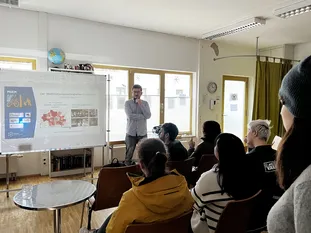
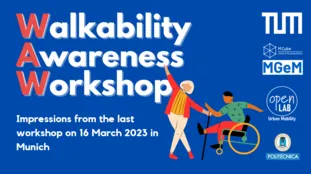
| 16 March 2023 | Walkability Awareness Workshop in Berg am Laim (see impressions here) |
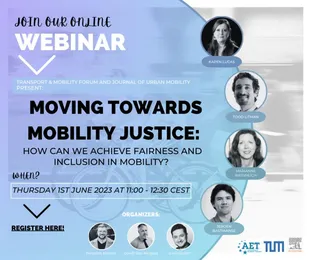
| 01 June 2023 | Webniar: Moving towards mobility justice |
| still available online | YouTube Video: Moving Towards Mobility Justice: How can we achieve fairness and inclusion in mobility? (watch here) |