The Smart Mobility Lab researches, analyzes, and designs future mobility systems based on data. The goal of our work is to develop mobility solutions that are resource-efficient, livable, and demand-oriented.
To achieve this, we combine large and heterogeneous data sources with analytical and model-based methods in order to understand, assess, and systematically improve mobility behavior, traffic flows, and system impacts at scale.
We consider mobility in its full breadth: from micromobility, cycling, and walking to private motorized transport, public transport, and bus systems, as well as commercial fleets, logistics, and heavy-duty applications. In doing so, we examine both passenger and freight mobility and analyze systems ranging from local operations to regional and city-wide scales.
Our research addresses questions such as:
- How will automated and connected mobility services such as robotaxis change future traffic patterns and mobility demand?
- What potential do shared mobility solutions have to reduce vehicle ownership and organize transport more efficiently?
- How can mobility patterns, traffic flows, and interactions between transport modes be derived from large-scale datasets?
- How can entire transport systems be modeled and their impacts evaluated in a robust way?
- What social costs and impacts does mobility create, and who moves where, when, how, and why?
- How can fleets be electrified, charging infrastructure dimensioned, and operational mobility systems optimized?
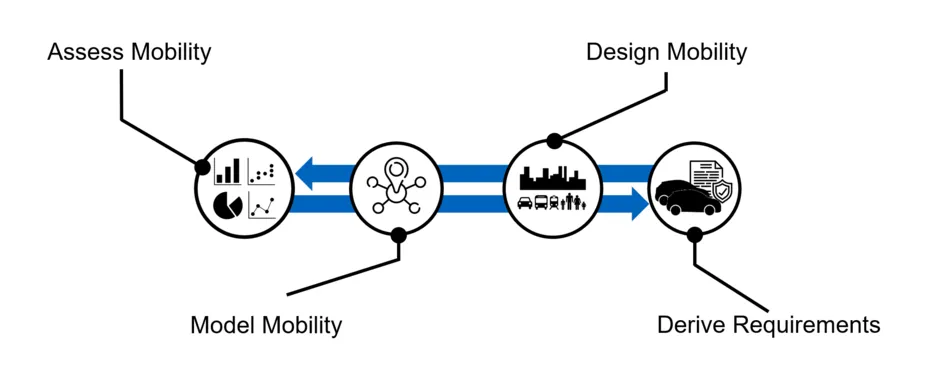
To answer these and other questions, we follow a data-driven four-step approach: understanding mobility, modeling mobility, shaping mobility, and deriving requirements.